
This museum grade fine art photograph is available in a fine art limited edition of 200, signed and numbered with a signed Certificate of Authenticity (COA) provided for additional provenance.
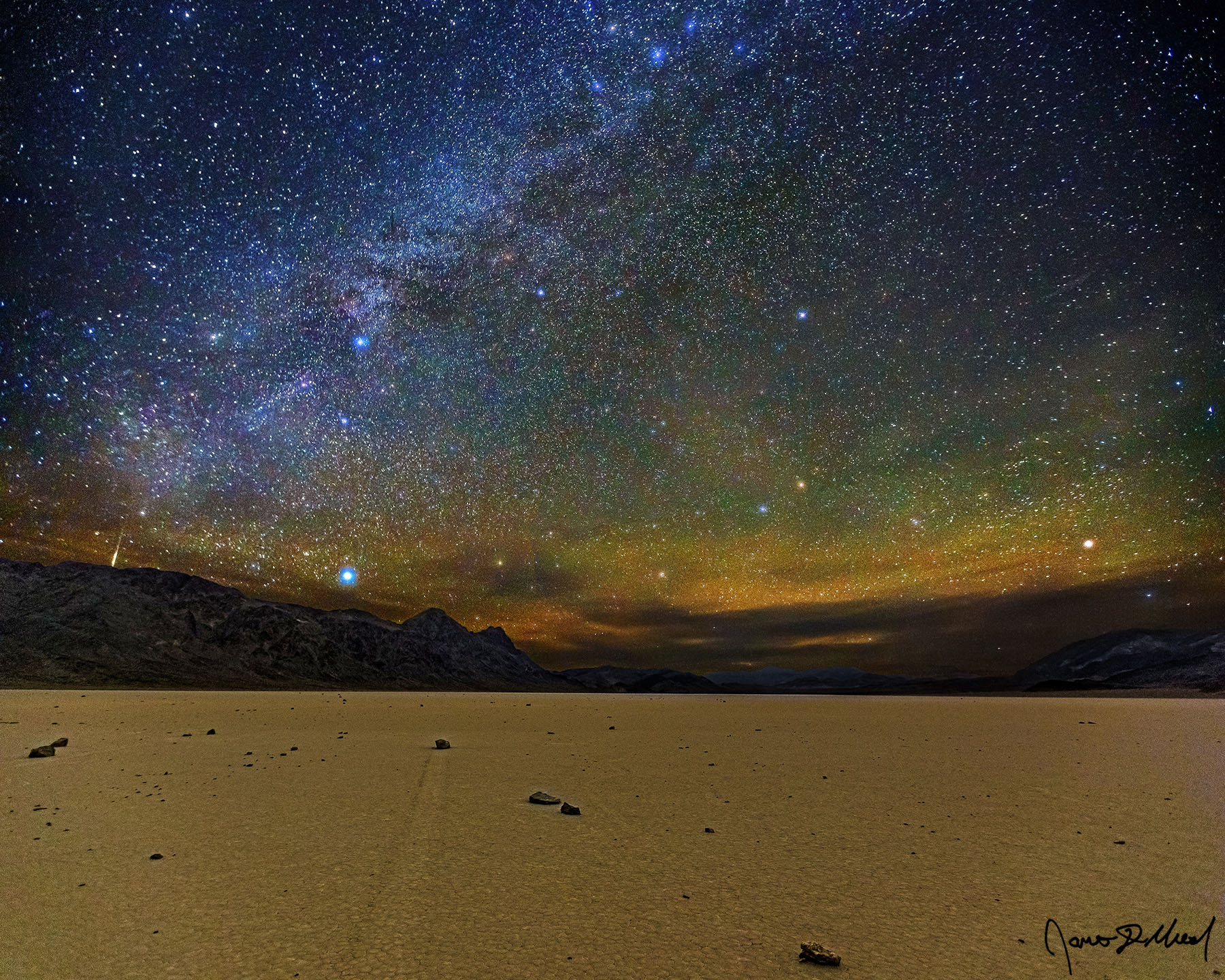
Night at the Races - Winter Milky Way and the North Star over Racetrack Playa, Death Valley, CA
Racetrack Playa, Death Valley National Park, California
The Winter Milky Way and a Meteor over Racetrack Playa in Death Valley National Park as Polaris, the Little Dipper and Cassiopeia Shine in Night Sky
The Winter Milky Way rises over Racetrack Playa in mid-November, tilting 70 degrees in the night sky above Polaris (the North Star). The famous sailing stones of The Racetrack leave trails in the dried mud of the playa high up in the mountain valleys of Death Valley National Park. A Northern Taurids meteor kisses the ridge of the Last Chance Range, as Airglow faintly illuminates the skies above and moisture in the air creates a diffused star glow around Vega, Deneb, Dubhe, Polaris, Kochab, and Pherkad. This helps make the Little Dipper and Polaris much more visible than it would be otherwise.
Racetrack playa sits framed by the Last Chance Range to the west and the Cottonwood Mountains to the east. The surface of the playa is covered in uniform, hexagonal mud cracks, a sharp contrast to the jigsaw patterns found in the mud cracks which occur in localized flood plains down in the main part of Death Valley. The sailing stones at Racetrack Playa leave a trail on the level, hexagon cracked surface of the playa as they move. A sailing stone and the trail it has left behind can be seen in this photo. Other, faint trails can be seen elsewhere in the photo if you look closely.
There's actually a lot going on in the night sky in this photo, Deneb is high in the sky in the middle of the Winter Milky Way spiral arm, and Vega sits just above the Last Chance Mountains to the right of the Milky Way. The North Star (Polaris) and the Little Dipper (Ursa Minor) are visible below the Winter Milky Way, something you don't often see with the Milky Way but can be seen during the late autumn and winter months. Cassiopeia's Chair (Cassiopeia) sits high in the sky above the spiral arm as Dubhe, the third brightest star in the Big Dipper, sits just above a wall of clouds hiding the rest of the asterism (a pattern of stars which is not an official constellation).
The History of Racetrack Playa and the Sailing Stones
Racetrack Playa is a dry lakebed (known as a playa) in Racetrack Valley, an endorheic basin situated between the Last Chance Range and the Cottonwood Mountains at an elevation of 3,714 feet covering between 4.5 and 5 square miles. It first appeared on the park maps in 1961 marked as The Racetrack back when Death Valley was still a national Monument. Previously, Ubehebe Peak had appeared on maps but not The Racetrack.
It takes some work to get here; its only access is via Racetrack Valley Road, a 27 mile journey down a rough, unpaved road filled with sharp rocks notorious for puncturing tires. A high clearance 4WD vehicle with puncture resistant (LT Rated) tires is usually required, as is at least one full sized spare. The only other option to get here is Lippincott Road; a narrow road with steep drop offs and sharp curves which is highly recommended to not take, especially with longer wheelbase 4WD vehicles.
Officially named The Racetrack by the USGS, it gets its name from the famous sailing stones which occur here. Rocks weighing from a few ounces up to 700 pounds move across the surface of the playa, leaving trail which can stretch up to 1500 feet behind them. The rocks themselves, composed of dolomite and syenite, fall down from the surrounding mountains as they erode onto the southern end of the playa, where mysterious forces cause them to move across the surface leaving trails as records of their movement in their wake.
Prospectors first visited the playa in the early 1900s, and it wasn't until 1948 that scientists began to study the mysterious sailing stones. The mystery of the sailing stones wouldn't be solved until 2014. In 2011, a team led by paleobiologist Richard Norris, his cousin James Norris, and planetary scientist Ralph Lorenz from the Scripps Institution of Oceanography at UC San Diego attached GPS trackers to 15 rocks and established a weather station on the playa.
In December 2013, James Norris and Richard Norris discovered the playa covered in a shallow pond of water about 3 inches deep. On December 21st, 2013 a little before noon they heard popping and cracking sounds coming from the frozen pond surface. After reviewing the motion activated GPS footage in 2014, the cause was finally revealed: as the playa fills with water, floating ice forms on cold nights. This creates sheets of "windowpane" ice which is thick enough to maintain its strength but thin enough to move freely. Once the sun comes out, the ice begins to melt and breaks into large panels which float on the surface. Light winds of as little as 10 miles per hour move the ice across the pool, and as the ice sheets move the rocks trapped in them as they slide across the muddy surface of the playa, leaving a trail in their wake as they move. The rocks move slowly, at about 6.5 to 19.6 feet per minute (2-6 meters per minute). The research revealed the rocks remained in motion anywhere from a few seconds to 16 minutes. If you visit the playa, you may see rock-less trails, which are caused by grounding ice sheets as they blow across the surface with no trapped rocks.
Sailing stones aren't the only natural feature here. The playa surface itself is covered in hexagon shaped mud cracks, a contrast from the jagged jigsaw puzzle formations which form down in the alluvial mud deposits down in Death Valley. These ephemeral formations occur along localized flood plains and alluvial mud deposits below the mountain washes. This creates mud made up of a fascinating mix of gravel, sand and clay which has an uneven drying rate that causes them to contract at differing rates. This uneven drying rate causes the uneven, jagged jigsaw puzzle patterns. In contrast, Racetrack Playa and similar playas have a fairly uniform mud composition making up the dried lakebed of the playa. This creates an even drying rate, which cracks in a pattern of 3 cracks intersecting, which forms uniform hexagon crack patterns across the landscape due to the more even sediment and uniform drying rate. It's an enchanting environment which seems straight off of another planet. In fact, the Curiosity rover found preserved, ancient hexagon shaped mud cracks on Mars. Between the sailing stone leaving tracks as they move across the playa surface and the hexagon shaped mud cracks covering it, The Racetrack is a fascinating place filled with wonder and awe.
Technical Specifications
- Camera: Canon EOS 5D Mark III
- Lens: Canon EF 16-35mm f/2.8L II USM
- Settings (Sky): 16mm | f/2.8 | 36 Seconds | 6400 ISO
- Settings (Foreground): 16mm | f/2.8 | 584 Seconds | 800 ISO
- Process: 5-Image Panoramic | Successive Back-to-Back Exposures using a Nodal Rail to Prevent Parallax Error | 4 Sky Exposures and 1 Foreground Exposure | Bespoke Multi-Layer Noise Management (Manual Masking to preserve details and raw data integrity)
Technical Note
A high-resolution panoramic stitch [4:5 Aspect Ratio] of 5 single exposure images using a nodal rail and L-bracket on a 3-way pan and tilt panoramic head for nodal point accuracy, ensuring the final photo preserves museum-grade detail and resolution across the entire frame, from the textures of Racetrack Playa, the sailing stones and the hexagon mud cracks to the Winter Milky Way and stars in the sky above.
Note on Provenance
Captured using the panoramic workflow of the "Mead Method" and light painting developed over 15 years of fine art landscape experience. This image preserves a genuine moment in time executed entirely in the field without the use of composites, sky swaps, or generative AI. Just a single moment in time, preserved.
Photo © copyright by James Mead.
Chromaluxe® Metal Prints | Gallery Float Ready to Hang
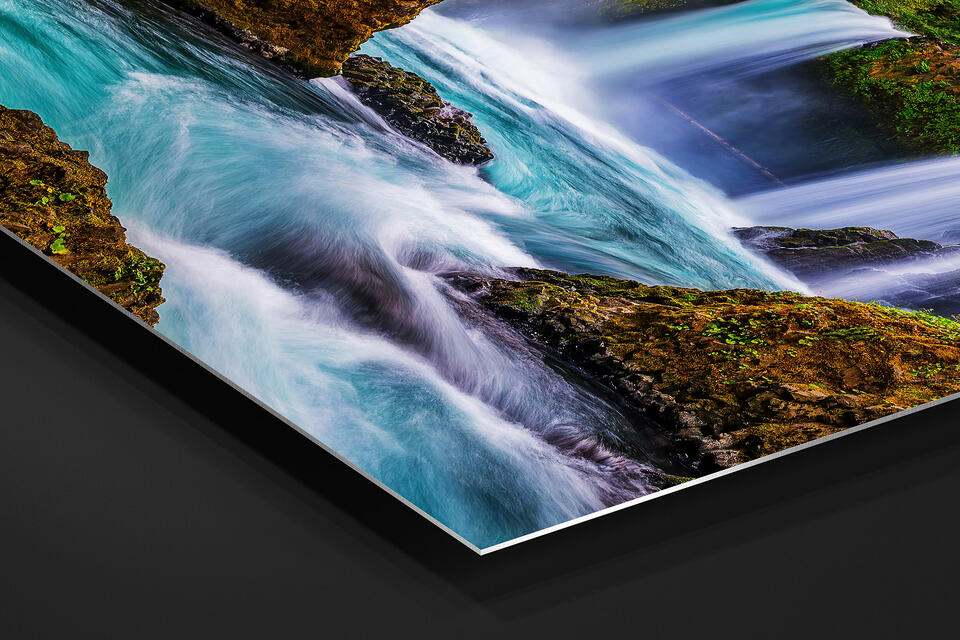
Vibrant. Modern. Impactful.
My Chromaluxe® Metal Fine Art Prints offer a sleek, modern presentation that’s both bold and beautiful. Using a high-heat dye sublimation process, each image is infused directly into a specially coated aluminum panel resulting in vibrant colors, ultra-sharp detail, and a striking glossy finish. The dye sublimation process infuses the image directly into the metal, creating a scratch resistant surface while helping provide permanent protection.
These prints feature:
• Vivid, color-rich surfaces ideal for modern spaces
• High contrast and incredible sharpness: perfect for clean compositions and bold landscapes
• Durable and lightweight aluminum construction
• Float mount backing for a frameless, floating display. Ready to hang out of the box
• Signed and Numbered Limited Editions of 200
• Signed Certificate of Authenticity (COA) provided for additional provenance
• Hand Crafted in the USA by our master printmakers
Please contact me for Alaska, Hawaii, and international shipping rates. Please allow 3-4 weeks for production and delivery.
These metal prints are ideal for collectors seeking a contemporary look with museum-quality output. Resistant to scratch, moisture and UV fading, they work beautifully in both home and office settings.
Select a print size:
Lumachrome TruLife® Acrylic HD Fine Art Prints | Gallery Float Ready to Hang
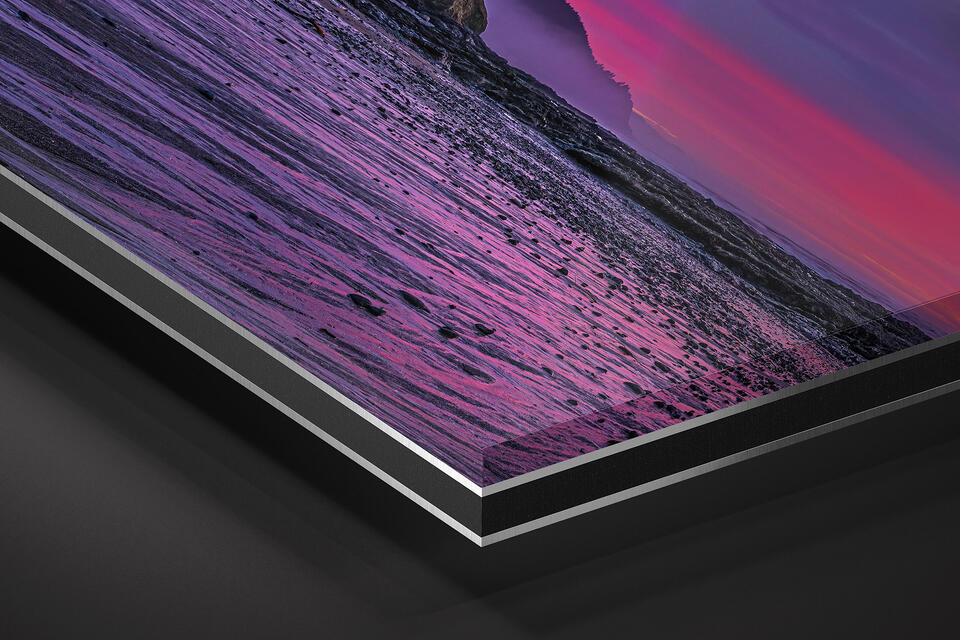
Museum-Grade Brilliance. Gallery-Worthy Depth.
Bring home the brilliance of nature with the industry’s finest print medium. My Lumachrome TruLife® Acrylic HD Fine Art Prints are crafted using a state-of-the-art process that infuses archival pigments into a transparency layer, backed by a clear acrylic backer and mounted under crystal-clear TruLife® acrylic. This creates a luminous, almost 3D effect. Colors appear to glow from within.
These gallery-grade prints feature:
• Incredible depth and clarity, fine details leap off the wall
• Exceptional color fidelity with deep saturation and smooth tonal gradations
• Anti-reflective, scratch-resistant museum grade 1/8” TruLife® acrylic offering unmatched viewing clarity under all lighting
• UV Resistant: TruLife® acrylic blocks up to 99% of UV rays
• 1/8" clear acrylic backer mounted using an archival adhesive layer
• 1.25” Roma wooden rear float mount frame inset 2” from the edge for a clean, frameless display that is ready to hang
• Signed and Numbered Limited Editions of 200
• Signed Certificate of Authenticity (COA) provided for additional provenance
• Hand Crafted in the USA by our master printmakers
• Ready to hang out of the box: no glass or framing required
Please contact me for Alaska, Hawaii, and international shipping rates. Please allow 3-4 weeks for production and delivery.
Whether you're designing a luxury interior or curating a personal gallery, these prints are built to impress and designed to last a lifetime.
Select a print size:
Roma Framed Lumachrome TruLife® Acrylic HD Fine Art Prints | Museum-Quality Ready to Hang
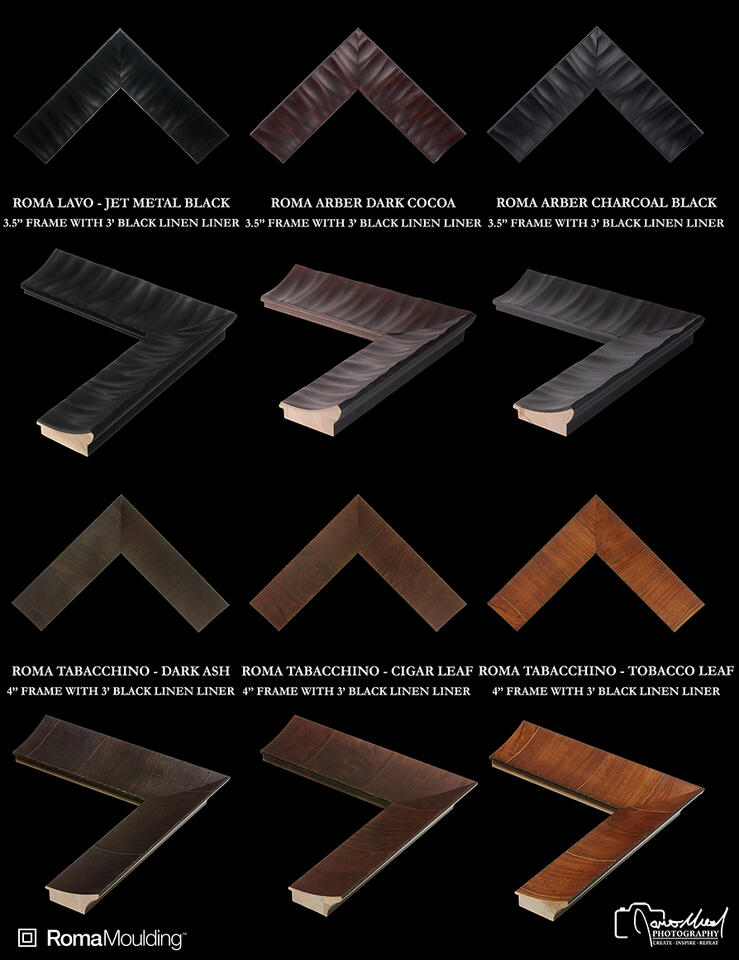
Timeless elegance. Unrivaled depth. A true centerpiece.
My Roma Framed Lumachrome TruLife® Acrylic HD Fine Art Prints represent the pinnacle of archival display. These statement pieces combine the award-winning brilliance of Lumachrome HD with the craftsmanship of custom Roma wood mouldings, transforming your chosen image into an heirloom-worthy work of art.
Each piece is handcrafted by master printmakers and framers in the USA using museum-grade materials. The print itself is infused with archival pigments into a transparency layer, mounted to an archival acrylic backer and face-mounted and sealed under a 1/8" layer of crystal-clear TruLife® acrylic: a premium optically-coated surface that eliminates reflections and enhances depth, vibrance, and clarity.
Surrounding this luminous presentation is your choice of genuine Roma Moulding, hand-built with a choice of 3.5" or 4" Italian made wooden Roma frame with a 3" black linen liner for a refined, framed, museum grade appearance. This adds approximately 13 to 14 inches to both the height and width of the final piece. This level of finish is rarely seen outside of luxury interiors and gallery exhibitions.
After placing your order, I’ll reach out personally to confirm your ideal frame and liner pairing from my curated Roma collection. If you’d prefer to finalize your framing choice in advance, feel free to reach out any time for a custom recommendation.
These museum grade works of art feature:
• Gallery-grade presentation with luminous depth and 3D effect
• TruLife® acrylic: anti-reflective, scratch-resistant, and blocks 99% of UV
• Archival quality construction with pH-neutral adhesive and backer
• Available in your choice of 3.5" or 4" Roma wood mouldings with a black linen liner for a framed, museum-grade appearance
• Museum-grade 3" black linen liner for added depth and visual separation
• Signed and Numbered Limited Editions of 200
• Signed Certificate of Authenticity (COA) provided for additional provenance
• Hand Crafted in the USA by our master printmakers
• Ready to hang out of the box: no glass or framing required
Please contact me for Alaska, Hawaii, and international shipping rates. Please allow 4-5 weeks for production and delivery.
Whether displayed in a luxury residence, corporate lobby, or fine art collection, these framed prints command attention and offer a sense of permanence few art mediums can match.
Select a print size:
These are investment-grade art pieces designed to last generations. If you have any questions, need any mock-ups or if you need anything else before purchase, please reach out and I will be in contact shortly.