
This museum grade fine art photograph is available in a fine art limited edition of 200, signed and numbered with a signed Certificate of Authenticity (COA) provided for additional provenance.
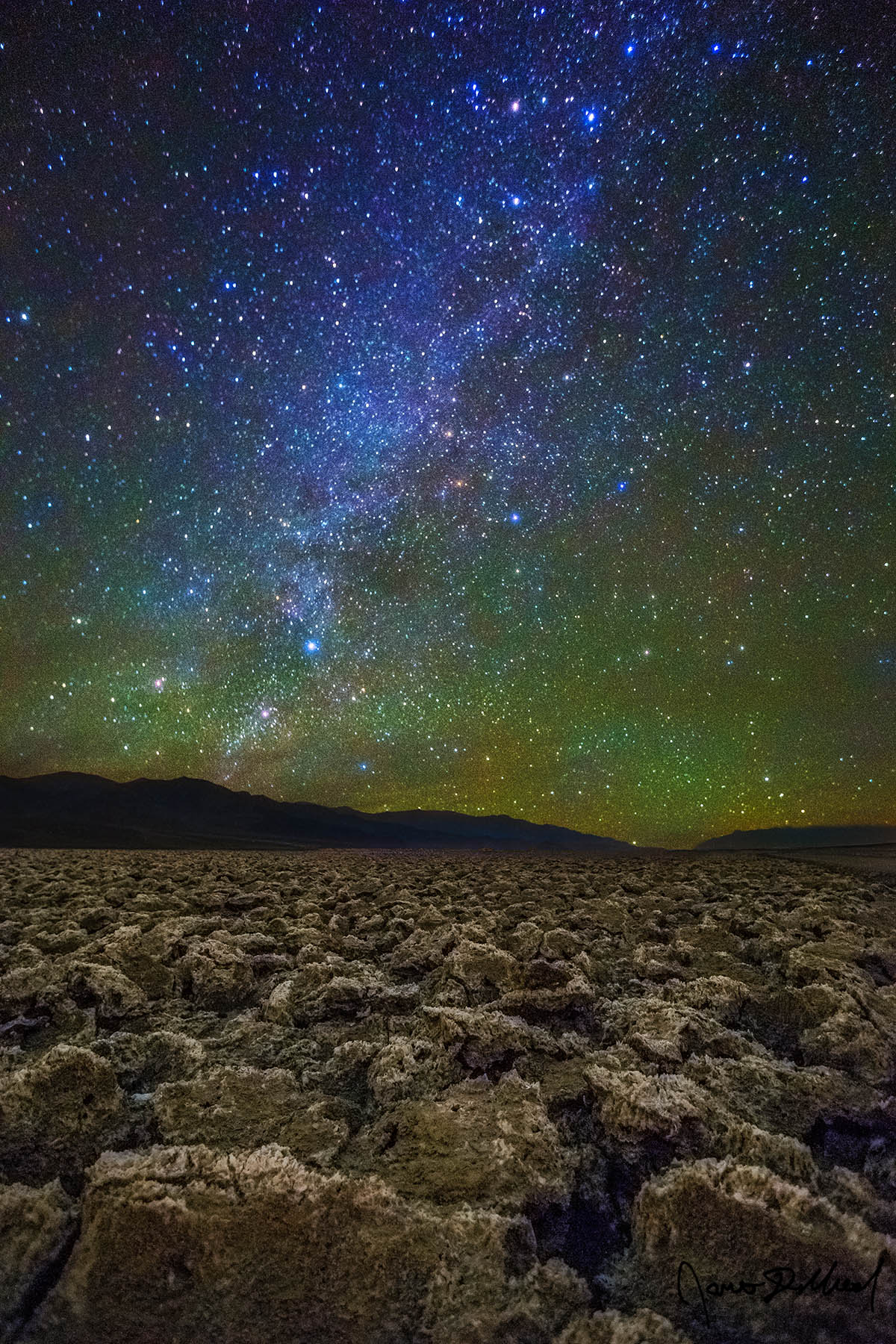
Starblast - Winter Milky Way, Green Airglow and Cassiopeia over Devils Golf Course, Death Valley, CA
Devils Golf Course, Death Valley National Park, California
The Winter Milky Way, Cassiopeia, the Northern Cross, Cepheus and Green Airglow over Devils Golf Course in Death Valley National Park
The Winter Milky Way rises high over the jagged spires and ridges of rock salt (halite) at Devils Golf Course in Death Valley National Park as vibrant green airglow illuminates the night sky. Deneb, Sadr and the Northern Cross hug the horizon, with the wings and tail of Cygnus visible just above the horizon. Cepheus shines brightly near the middle of the night sky in the frame, while Cassiopeia's Chair (Cassiopeia) shines brightly high overhead. Eltanin (also historically known as Etamin), the brightest star in the northern constellation Draco, kisses the lower ridge of the northern slopes of the Panamint Range below Tucki Mountain as it rises above Devils Golf Course to a height of 6736 feet (NAVD 88 GS0796) in the distance. There's a bit of moisture in the air this night, which gives the stars in the night sky a stellar diffused glow not present in some of my other photos of the Milky Way taken here such as Boulder Path and Cracked Starlight, where less moisture was present in the air resulting in a beautiful night Milky Way sky photo without the diffused star glow present here.
The History of Devils Golf Course and Its Name
Devil's Golf Course got its name in 1934 when a guide book published by the US Department of the Interior and National Park Service stated the terrain was so rugged "for only the devil could play golf on such a course." Page six of the 1934 Death Valley National Monument guidebook describes the area well: "The Devil's Golf Course, lying south of Furnace Creek, is an expanse of salt, crystallized into weird and fantastic shapes varying from an inch to more than 3 feet in height. These dwarfed and twisted pinnacles cover the area so closely that a flat space large enough to lay one's hat cannot be found. The salt is not just thin surface strata; a well reached a depth of over a thousand feet, and except for a few thin layers of clay the rest was salt. This area is well named, for only the devil could play golf on such a course."
It's not clear whether this referred to the modern day Devils Golf Course or the earlier locations appearing on the early park maps, though it's safe to assume it started as the latter and changed over time. The location now known as Devils Golf Course appeared on NPS maps as 'Salt Pools' from the first park map in 1933 through at least 1958. By the 1961 park maps, the name Salt Pools was removed with Devils Golf Course replacing the Salt Pools location on the maps (with the exception of one 1965 brochure anomalously reverting to the older name). From the first 1933 maps through at least 1958, Devils Golf Course on the maps referred to an area ranging from Salt Pools (modern day Devils Golf Course) northward into Middle Basin north of where West Side Road branches off Badwater Road and south of Furnace Creek. The descriptive term 'Devils Golf Course' first appeared in the 1934 NPS guidebook, and by 1961 had replaced 'Salt Pools' on official NPS cartography maps for this location, a 25-year naming transition documented in NPS publications.
This change was likely because the park service had originally kept the naturally occurring salt pools at Devils Golf Course open with dynamite, but understandably stopped this practice at some point. It is reasonable to assume the map name change in 1961 coincided with the decision to stop the practice of artificially keeping the pools at Devils Golf Course open with dynamite. Now, the salt pools occur at random naturally due to sinkholes, though they will always eventually crust over with salt and close up. As such, they are no longer marked or mentioned on modern day maps as the name no longer accurately reflects what visitors will find there.
If you listen closely on warm days, you can hear the salt make a cracking sound as it expands and contracts. It's a rugged salt pan consisting of dry, weathered, wind, and rain sculpted deposits of thick salt. The salt formations here are made of Halite (commonly known as rock salt) mixed with bits of borax. Unlike the flat honeycomb hexagon salt rings of Badwater Basin 5 miles to the south of here, the formations at Devils Golf Course are jagged, rugged, tough spiky pinnacles. The salt pan sits at a slightly higher elevation than Badwater Basin, -276 feet below sea level (Garmin GPS and Gaia GPS, consistent with USGS topographic elevation). With no outlet, the waters of Ancient Lake Manly deposited salt and other minerals into the lake bed as it dried out, eventually forming Badwater Basin and Devils Golf Course.
There's a lot of misinformation floating around about what causes the salt formations at Devils Golf Course. Many popular travel blogs incorrectly state that the spires and formations at Devils Golf Course grow via "capillary action," the vertical pumping of briny groundwater to the surface. The 1966 USGS Report 494-B written by Charles Hunt debunks this claim with the actual cause of the growth here.
Instead of vertical capillary action, the primary driver is lateral groundwater seepage from nearby flood plains into the ground beneath the smooth salt crust. Here at Devils Golf Course, where the smooth salt flat meets the edge of a flood plain, water seeps sideways into the ground beneath the smooth salt crust. As that water evaporates, it deposits more salt crystals underneath. Those growing salt crystals deposited beneath the crust push upward with enough force to heave and buckle the smooth surface above them, eventually turning it into the rough, jagged formations of Devil's Golf Course (p B62, right column, 5th paragraph).
Long before Death Valley became a National Monument in 1934, the Pacific Coast Borax Company drilled holes here in search of potash. They found "interbedded salt and mud, with some minor sand and gravel" underneath the salt pan here as deep as they drilled, which was more than 1,000 feet deep in some places. Later research suggests the deposits in some places in the valley are much deeper, as much as 9,000 feet thick near Mormon Point, less than 4,000 feet thick west of Artists Drive. The original 1937 park brochure refers to drilling of over 1,000 feet of alternating layers of clay and salt without reaching bedrock. It states "that the rock floor of the valley at this place must lie more than 1,250 feet below sea level."
Technical Specifications
- Camera: Canon EOS 5D Mark III
- Lens: Canon EF 16-35mm f/2.8L II USM
- Settings (Sky): 20mm | f/2.8 | 36 Seconds | 6400 ISO
- Settings (Foreground): 20mm | f/2.8 | 352 Seconds | 1600 ISO
- Process: 2-Image Blend for Dynamic Range | Successive Back-to-Back Exposures | Bespoke Multi-Layer Noise Management (Manual Masking to preserve shadow integrity and astronomical detail)
Technical Note
This photo uses a method of blending a short sky exposure with a longer foreground exposure in order to achieve clean details in the shadows while retaining the natural, proper exposure value of the scene under starlight. This is not a blue hour blend. The sky frame was taken first at the proper exposure settings, followed by the foreground at 352 seconds. Figuring out the 352 second exposure to properly illuminate the foreground required mental exposure extrapolation based on the initial sky exposure settings, as I mentally calculated the proper exposure settings for the foreground. The result preserves the authentic relationship between the night sky and the surrounding landscape, exactly as the scene appeared.
Note on Provenance
Captured using the workflow of the "Mead Method," developed over 15 years of fine art landscape experience. This image preserves a genuine, single moment in time. It is natural to the scene as it was taken. Exposures were taken back to back, one immediately after the other. As always, no generative AI is ever used in my work.
Photo © copyright by James Mead.
Chromaluxe® Metal Prints | Gallery Float Ready to Hang
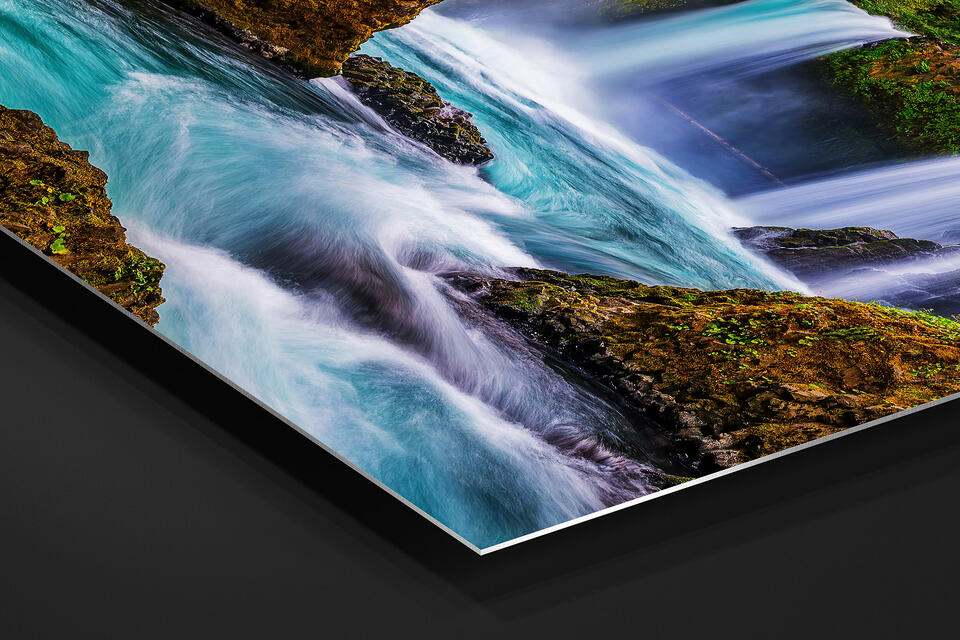
Vibrant. Modern. Impactful.
My Chromaluxe® Metal Fine Art Prints offer a sleek, modern presentation that’s both bold and beautiful. Using a high-heat dye sublimation process, each image is infused directly into a specially coated aluminum panel resulting in vibrant colors, ultra-sharp detail, and a striking glossy finish. The dye sublimation process infuses the image directly into the metal, creating a scratch resistant surface while helping provide permanent protection.
These prints feature:
• Vivid, color-rich surfaces ideal for modern spaces
• High contrast and incredible sharpness: perfect for clean compositions and bold landscapes
• Durable and lightweight aluminum construction
• Float mount backing for a frameless, floating display. Ready to hang out of the box
• Signed and Numbered Limited Editions of 200
• Signed Certificate of Authenticity (COA) provided for additional provenance
• Hand Crafted in the USA by our master printmakers
Please contact me for Alaska, Hawaii, and international shipping rates. Please allow 3-4 weeks for production and delivery.
These metal prints are ideal for collectors seeking a contemporary look with museum-quality output. Resistant to scratch, moisture and UV fading, they work beautifully in both home and office settings.
Select a print size:
Lumachrome TruLife® Acrylic HD Fine Art Prints | Gallery Float Ready to Hang
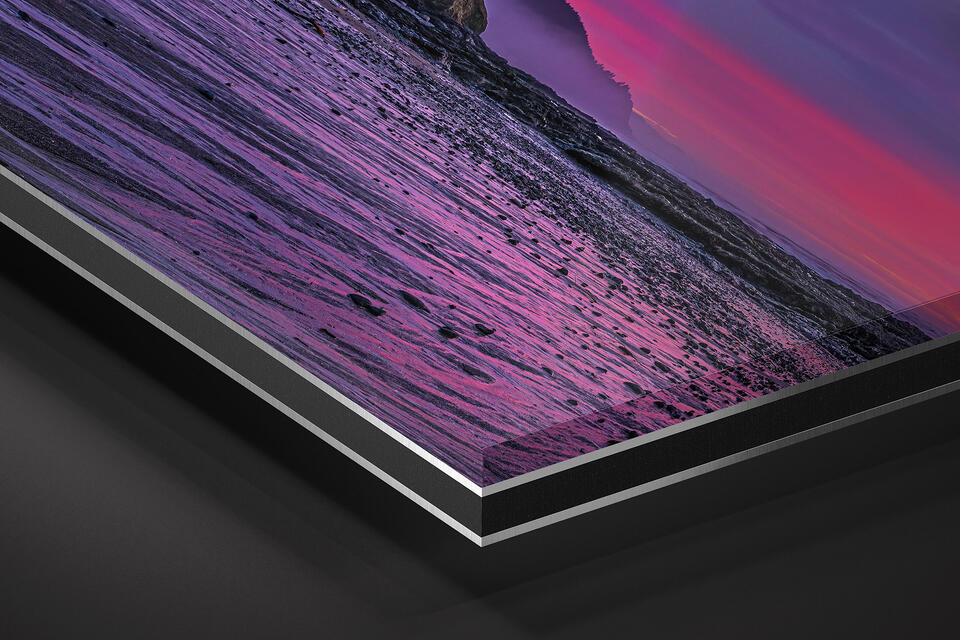
Museum-Grade Brilliance. Gallery-Worthy Depth.
Bring home the brilliance of nature with the industry’s finest print medium. My Lumachrome TruLife® Acrylic HD Fine Art Prints are crafted using a state-of-the-art process that infuses archival pigments into a transparency layer, backed by a clear acrylic backer and mounted under crystal-clear TruLife® acrylic. This creates a luminous, almost 3D effect. Colors appear to glow from within.
These gallery-grade prints feature:
• Incredible depth and clarity, fine details leap off the wall
• Exceptional color fidelity with deep saturation and smooth tonal gradations
• Anti-reflective, scratch-resistant museum grade 1/8” TruLife® acrylic offering unmatched viewing clarity under all lighting
• UV Resistant: TruLife® acrylic blocks up to 99% of UV rays
• 1/8" clear acrylic backer mounted using an archival adhesive layer
• 1.25” Roma wooden rear float mount frame inset 2” from the edge for a clean, frameless display that is ready to hang
• Signed and Numbered Limited Editions of 200
• Signed Certificate of Authenticity (COA) provided for additional provenance
• Hand Crafted in the USA by our master printmakers
• Ready to hang out of the box: no glass or framing required
Please contact me for Alaska, Hawaii, and international shipping rates. Please allow 3-4 weeks for production and delivery.
Whether you're designing a luxury interior or curating a personal gallery, these prints are built to impress and designed to last a lifetime.
Select a print size:
Roma Framed Lumachrome TruLife® Acrylic HD Fine Art Prints | Museum-Quality Ready to Hang
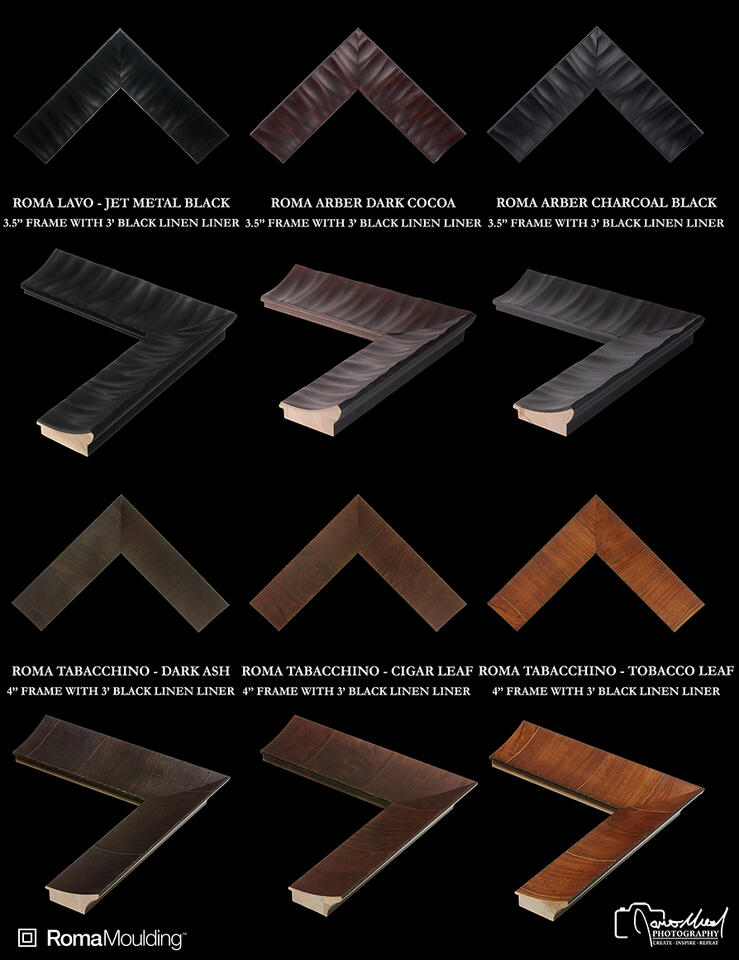
Timeless elegance. Unrivaled depth. A true centerpiece.
My Roma Framed Lumachrome TruLife® Acrylic HD Fine Art Prints represent the pinnacle of archival display. These statement pieces combine the award-winning brilliance of Lumachrome HD with the craftsmanship of custom Roma wood mouldings, transforming your chosen image into an heirloom-worthy work of art.
Each piece is handcrafted by master printmakers and framers in the USA using museum-grade materials. The print itself is infused with archival pigments into a transparency layer, mounted to an archival acrylic backer and face-mounted and sealed under a 1/8" layer of crystal-clear TruLife® acrylic: a premium optically-coated surface that eliminates reflections and enhances depth, vibrance, and clarity.
Surrounding this luminous presentation is your choice of genuine Roma Moulding, hand-built with a choice of 3.5" or 4" Italian made wooden Roma frame with a 3" black linen liner for a refined, framed, museum grade appearance. This adds approximately 13 to 14 inches to both the height and width of the final piece. This level of finish is rarely seen outside of luxury interiors and gallery exhibitions.
After placing your order, I’ll reach out personally to confirm your ideal frame and liner pairing from my curated Roma collection. If you’d prefer to finalize your framing choice in advance, feel free to reach out any time for a custom recommendation.
These museum grade works of art feature:
• Gallery-grade presentation with luminous depth and 3D effect
• TruLife® acrylic: anti-reflective, scratch-resistant, and blocks 99% of UV
• Archival quality construction with pH-neutral adhesive and backer
• Available in your choice of 3.5" or 4" Roma wood mouldings with a black linen liner for a framed, museum-grade appearance
• Museum-grade 3" black linen liner for added depth and visual separation
• Signed and Numbered Limited Editions of 200
• Signed Certificate of Authenticity (COA) provided for additional provenance
• Hand Crafted in the USA by our master printmakers
• Ready to hang out of the box: no glass or framing required
Please contact me for Alaska, Hawaii, and international shipping rates. Please allow 4-5 weeks for production and delivery.
Whether displayed in a luxury residence, corporate lobby, or fine art collection, these framed prints command attention and offer a sense of permanence few art mediums can match.
Select a print size:
These are investment-grade art pieces designed to last generations. If you have any questions, need any mock-ups or if you need anything else before purchase, please reach out and I will be in contact shortly.